
Expert Pathways in multilingual classrooms

This article presents Expert Pathways, a classroom framework that helps multilingual learners interpret complex texts by drawing on their existing knowledge and interests. The approach supports academic discussion and writing while maintaining shared texts and rigorous inquiry.
Keywords: multilingual learners; disciplinary literacy; academic discourse; text interpretation; adult and secondary ESL; classroom practice
Developing the ability to interpret complex texts and participate in rigorous academic discourse is a central goal for multilingual learners. For many students, the challenge lies in ensuring that classroom participation reflects their true conceptual knowledge and intellectual depth, independent of their current proficiency in a second language. However, many multilingual learners demonstrate stronger receptive skills than productive skills, often understanding texts but hesitating to express interpretations. This gap has been widely attributed to foreign language anxiety and greater self-monitoring for accuracy, thus disproportionately affecting speaking and writing (Horwitz et al., 1986; MacIntyre & Gardner, 1994). As teachers, we frequently face the challenge of helping students bridge this gap between what they know and how they express their knowledge.
Statement of the problem
Learners may frequently delay or avoid production due to concerns about making linguistic errors which result in hesitation and reduced fluency (Tanveer, 2007). When cognitive effort from limited attentional capacity and working memory constraints is directed primarily toward linguistic form, fewer resources remain available for conceptualization and message formulation, which can limit learners’ ability to express ideas they understand conceptually (Juffs & Harrington, 2011; Robinson, 2003; Skehan, 2014).
Instructional structures that allow learners to engage from positions of knowledge can reduce these barriers and support more sustained academic discourse (Kayi-Aydar, 2014; Northedge, 2003).
Framework overview and purpose
As described in this article, I developed Expert Pathways to support multilingual learners in interpreting complex texts through conceptual knowledge they already possess. Rather than reducing linguistic demand, the framework redistributes cognitive load by anchoring interpretation in learners’ existing knowledge.
Design rationale and process
Theoretical grounding
Advanced second-language learners frequently hesitate when asked to speak or write in English despite demonstrating strong comprehension when reading or listening (Horwitz et al., 1986; MacIntyre & Gardner, 1994; Tanveer, 2007). This hesitation often reflects the cognitive cost of language production combined with heightened self-monitoring (Kormos, 2006; Levelt, 1989). When instructional prompts foreground linguistic performance rather than conceptual understanding, students may produce responses that underestimate what they know (Abedi, 2010; Ardasheva et al., 2012; Kieffer et al. 2009).
It is important to note that Expert Pathways attempts to address issues of hesitation by allowing learners to approach shared texts through disciplinary lenses aligned with their intellectual backgrounds. All learners engage with the same texts and essential questions. What varies is the interpretive perspective through which learners examine the material.
From a literacy perspective, this framework reflects research showing that comprehension improves when readers connect new information to existing conceptual knowledge and when they approach texts through disciplinary ways of thinking (Alexander, 2003; Shanahan & Shanahan, 2008; Snow, 2002; Willingham, 2009). In practice, learners often produce more substantive interpretations when they can draw on knowledge already familiar to them (Carrell & Eisterhold, 1983; Nassaji, 2007).
Participant characteristics and course context
The students in this course consisted of young adults who were, as adolescents, participants in the English Access Microscholarship Program in Eurasia, a program sponsored by the U.S. Department of State, which provided English language and leadership skills to talented but economically disadvantaged youth worldwide. As a cornerstone of U.S. public diplomacy, the program aimed to strengthen mutual understanding by exposing participants to American culture and democratic values, ultimately fostering global stability and creating educational and economic opportunities for future leaders. Most of the Access Alumni participants were early-career individuals whereas some were still completing university studies. Given the currently strained diplomatic climate, the specific nation of origin for these Access Alumni students is not identified in this manuscript to protect participant privacy and to maintain institutional confidentiality.
Design workflow and planning logistics
Unlike instructional models that attempt to categorize learners by cognitive type, the Expert Pathways focus centers on interpretive lenses connected to learners’ knowledge and intellectual interests. Figure 1 illustrates the instructional sequence used to develop Expert Pathways and the workflow through which learner background information informs the design of pathways that support interpretation of shared texts and participation in academic discourse.
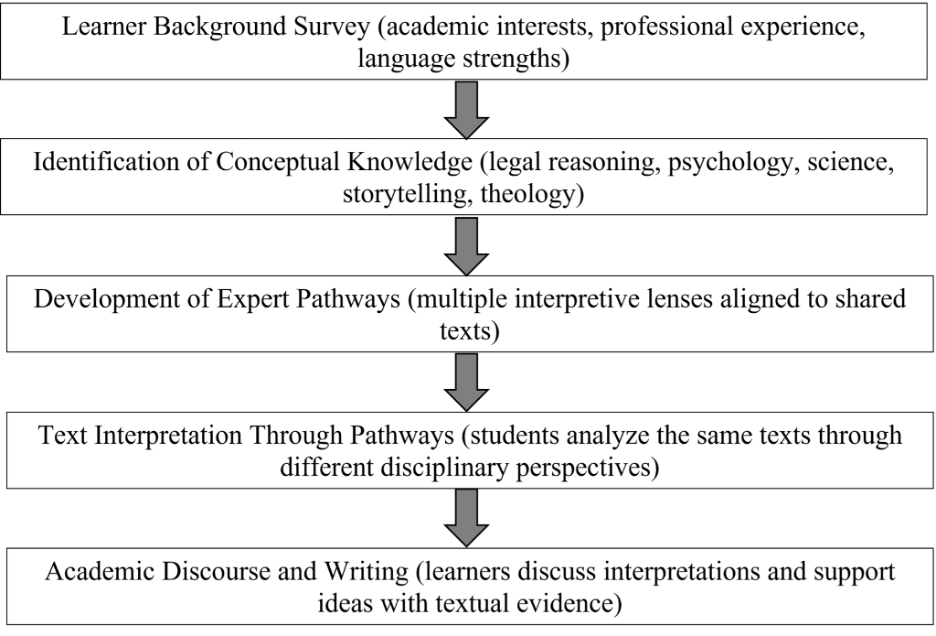
At the beginning of the course, I gave students a “get to know you” survey to learn more about their hobbies, interests, career fields (or future career aspirations), and personal goals for their achievement in the course. I also asked them to self-assess their abilities across the domains of reading, writing, speaking, and listening. The host institution requested a course centered on American literature and culture. Because many participants had limited access to print texts, materials were selected primarily from public-domain or easily accessible online sources. The course used seasonal literature as an organizing framework and included works such as Hawthorne’s Young Goodman Brown, excerpts from Walden, Ethan Frome, selected poems of Mary Oliver, and folklore such as La Llorona. Rather than simplifying texts, Expert Pathways allowed learners to approach shared readings through disciplinary or interest-based interpretive lenses. Pathway variations were generated efficiently through structured brainstorming and planning tools, including generative artificial intelligence (AI). Representative examples are provided in Table 1.
Table 1. Example Expert Pathways for Interpreting Shared Texts
| Pathway | Conceptual Focus | Example Guiding Questions | Example Language Support |
| Legal and Institutional | Evidence, testimony, authority | What counts as evidence in the Salem trials? | The evidence suggests that… |
| Psychological | Fear, projection, moral panic | How might fear influence the behavior of individuals? | One explanation could be… |
| Linguistic and Discourse | Language of accusation and naming | How does language shape accusations? | The wording suggests… |
| Theological and Ethical | Belief, morality, covenant | How do religious beliefs influence decisions? | From an ethical perspective… |
| Systems and Evidence | Patterns in social behavior | How do accusations spread in communities? | A pattern that emerges is… |
| Creative and Identity | Narrative voice and symbolism | How might the story change from another perspective? | If the story were told from… |
To illustrate how these pathways function within a complete assignment, a full example is provided here: Example Expert Pathways Assignment: La Llorona Across Disciplines.
Implementation
In lessons involving historical inquiry, I created essential questions and paired selected texts, providing scaffolding that would support participants who had lower proficiency levels so that they could confidently contribute to conversations and respond to texts. To this end, the framework incorporated explicit language scaffolds including vocabulary support, sentence frames, modeled responses, and structured prompts guiding interpretation of texts.
Learners often rehearsed ideas orally before writing and worked collaboratively in small groups when developing responses. These structures allowed students to test interpretations in conversation before expressing them in written form. Adaptations for lower-proficiency learners included shorter excerpts, simplified retellings, visual supports, and collaborative writing tasks. These adjustments reduced linguistic load without reducing conceptual complexity. I offered a variety of Expert Pathways from which students could draw, and from there, their creativity flowed.
In poetry lessons, learners responded especially strongly to Mary Oliver’s observational style and accessible language. One participant approached Oliver’s poem “Spring” through the lens of homemaking and seasonal renewal, which generated extended discussion among the group. Frequently in our class, the word serendipitous came up, and this discussion was truly an example of one of those occasions.
Cross-age adaptability
Although the participants described here were highly proficient young adults, the framework can also be adapted for younger learners or lower proficiency levels through additional scaffolding and pathways built around hobbies, everyday experiences, or emerging interests.
Observed outcomes
Across pathways, learners demonstrated increased willingness to contribute to extended academic discourse. Students who initially hesitated to speak or offered brief responses began producing longer, multi-sentence interpretations that referenced textual evidence and moved beyond literal comprehension. Table 2 presents verbatim participant reflections illustrating increased participation in extended academic discourse, greater willingness to articulate interpretations in English, and sustained engagement with complex themes.
As an example, in our lessons about the Salem Witch Trials, the othering of Tituba, the generational burden Nathaniel Hawthorne carried as the great-great-grandson of John Hathorne, an unrepentant magistrate during the Salem Witch Trials, and the themes within Young Goodman Brown, learners engaged with themes such as fear, belief, authority, and moral responsibility while grounding their interpretations in textual evidence. Discussions frequently moved beyond literal comprehension toward broader questions about social dynamics and historical context.
Although these observations were qualitative rather than formally measured, similar patterns appeared across multiple discussions and written responses. Learners consistently produced richer interpretations when they approached texts through conceptual knowledge already familiar to them.
Table 2. Participant reflections on expert pathways (verbatim excerpts; minor language features reflect original production).
| Participant | Lens/Angle | Excerpt |
| E.I. | Homemaker perspective on spring | I was really glad to work further using expert pathways. It really helped me to dig deeper and understand the subject better!!! I was really glad to use expert pathways on discussing Mary Oliver’s poem. I’ve done a research on spring how it affects our diets, cleaning, mood and etc. from “homemaker’s” perspective. It was great to learn something new and discover the roots of simple things that we do in our everyday lives!!! |
| V.K. | Linguistic / etymological focus | I think it helped me to explore the texts and connections of the words better, follow the etymology, and as a result it inspired to create own writing. It was a real pleasure to participate in all the discussions, thank you so much for such a friendly and supportive atmosphere, where a fear of mistakes can disappear. |
| E.Z. | Professional / interdisciplinary lenses | Expert Pathways make it easier to connect a piece of literature to our own lives. When viewing through the lens of a modern-day professional, certain aspects (e.g., specific visual historical details and visual associations as an artist, or psychological tension and bias as a psychologist) tend to stick in memory and can be easily recalled even after some time. I believe many students struggle to remember details from the book they read a while ago, but connecting the book to relevant personal professional experiences is an effective way to memorize these details, it just happens naturally. Expert Pathways also do extend conversations because we can access a piece of literature through the perspective, for example, of a peer lawyer, and having them share their insights helps us understand modern law alongside the laws of the past (e.g., how would someone be imprisoned in those days vs today, and how does this illustrate progress and changes in mindset?) This approach expands our knowledge of literature while also enhancing our understanding of the world and its various aspects. |
| M.P. | Structured / individualized access | I believe that “Expert Pathways” helped me to access the texts better, because it structures information in more “specific” way for each person and makes it easier to understand the assignment Thank you for that course, it was really interesting |
| T.T. | Legal / analytical lens | I really appreciated working with the “Expert Pathways” format. In my experience, many teachers in [country omitted] tend to assign the same type of task to everyone, or at most offer one alternative option. While this can be effective, it doesn’t always engage students’ individual interests or strengths. What I found especially valuable in your approach is the idea of inviting students to become “experts” in a particular field. This not only aligns with their personal interests and, in some cases, their professional background, but also encourages deeper engagement, creativity, and genuine intellectual discovery. For example, when we studied the Salem witch trials and the case of Giles Corey, I had never considered the legal dimension of his silence. I was surprised to learn that he refused to enter a plea — neither guilty nor not guilty — and instead remained silent in order to preserve his property for his descendants. It was only by approaching the case from a legal perspective that this detail became meaningful to me. Tasks like these make learning feel less like completing an assignment and more like exploring a question from a perspective that truly matters to you. |
Classroom takeaways
Teachers interested in implementing Expert Pathways can begin with three practical steps:
1. Identify learner knowledge
Use a brief survey or conversation to learn about students’ academic interests, professional experiences, or personal passions.
2. Design multiple interpretive lenses
Create several pathways through which students can analyze the same text or topic. Again, brainstorming with generative AI as a vehicle to accomplish this may help teachers easily and efficiently consider multiple pathways by which learners can access the text through their lens of interest.
3. Maintain shared texts and questions
All learners should engage with the same material. The intent of the pathways is only to vary the interpretive perspective, not to diminish the intellectual rigor.
Limitations
As a practitioner-led inquiry, the observations described here are based on classroom implementation rather than formal experimental study. Outcomes were documented through instructional observation, learner discussion, and written responses rather than via controlled measurement.
Additionally, the learning community described here included participants with diverse academic and professional backgrounds. In classrooms where learners have less-developed academic specialization, pathways may need to be built around personal interests, hobbies, or everyday knowledge. In K-12 classrooms, similar pathways can be built around students’ emerging areas of expertise such as interests in science, storytelling, sports, art, or technology.
Finally, the instructional context was an online multilingual classroom serving learners across Eurasia. Further implementation in other educational settings would help clarify how the framework functions in different institutional contexts, including in K–12 classrooms and university courses.
Conclusion
The Expert Pathways framework provides a structured method for connecting learners’ existing knowledge to the interpretation of complex texts. By inviting students to engage from positions of intellectual familiarity, the framework reduces affective barriers while maintaining academic rigor.
When learners approach texts through conceptual knowledge they already possess, classroom interpretation becomes a collaborative exploration of ideas rather than an exercise solely based in linguistic performance. In multilingual classrooms, this shift can create conditions for richer academic discourse and deeper engagement with texts.
References
Abedi, J. (2010). Performance assessments for English language learners. Stanford University, Stanford Center for Opportunity Policy in Education.
Alexander, P. A. (2003). The development of expertise: The journey from acclimation to proficiency. Educational Researcher, 32(8), 10–14. https://doi.org/10.3102/0013189X032008010
Ardasheva, Y., Tretter, T. R., & Kinny, M. (2012). English language learners and academic achievement: Revisiting the threshold hypothesis. Language Learning, 62(3), 769–812. https://doi.org/10.1111/j.1467-9922.2011.00652.x
Carrell, P. L., & Eisterhold, J. C. (1983). Schema theory and ESL reading pedagogy. TESOL Quarterly, 17(4), 553–573. https://doi.org/10.2307/3586613
Horwitz, E. K., Horwitz, M. B., & Cope, J. (1986). Foreign language classroom anxiety. The Modern Language Journal, 70(2), 125–132. https://doi.org/10.1111/j.1540-4781.1986.tb05256.x
Juffs, A., & Harrington, M. (2011). Aspects of working memory in L2 learning. Language Teaching, 44(2), 137–166. https://doi.org/10.1017/s0261444810000509
Kayi-Aydar, H. (2014). Social positioning, participation, and second language learning: Talkative students in an academic ESL classroom. TESOL Quarterly, 48(4), 686−714. https://doi.org/10.1002/tesq.139
Kieffer, M. J., Lesaux, N. K., & Rivera, M. (2009). Accommodations for English language learners taking large-scale assessments: A meta-analysis on effectiveness and validity. Review of Educational Research, 79(3), 1168−1201. https://doi.org/10.3102/0034654309332490
Kormos, J. (2006). Speech production and second language acquisition. Lawrence Erlbaum Associates Publishers.
Levelt, W. J. M. (1989). Speaking: From intention to articulation. The MIT Press.
MacIntyre, P. D., & Gardner, R. C. (1994). The subtle effects of language anxiety on cognitive processing in the second language. Language Learning, 44(2), 283–305. https://doi.org/10.1111/j.1467-1770.1994.tb01103.x
Nassaji, H. (2007). Schema theory and knowledge-based processes in L2 reading comprehension: A need for alternative perspectives. Language Learning, 57(S1), 79–113. https://doi.org/10.1111/j.1467-9922.2007.00413.x
Northedge, A. (2003). Enabling participation in academic discourse. Teaching in Higher Education, 8(2), 169–180. https://doi.org/10.1080/1356251032000052429
Robinson, P. (2003). Attention and memory during SLA. In C. Doughty & M. Long (Eds.), Handbook of Second Language Acquisition (pp. 631–678). Blackwell.
Shanahan, T., & Shanahan, C. (2008). Teaching disciplinary literacy to adolescents. Harvard Educational Review, 78(1), 40–59. https://doi.org/10.17763/haer.78.1.v62444321p602101
Skehan, P. (2014). Limited attentional capacity, second language performance and task-based pedagogy. In Skehan, P. (Ed.), Processing perspectives on task performance (pp. 211–260). John Benjamins. https://doi.org/10.1075/tblt.5
Snow, C. (2002). Reading for understanding: Toward an R&D program in reading comprehension. RAND Corporation. https://www.rand.org/pubs/monograph_reports/MR1465.html
Tanveer, M. (2007). Investigation of the factors that cause language anxiety for ESL/EFL learners in learning speaking skills and the influence it casts on communication in the target language [Master’s Thesis, University of Glasgow]. https://doi.org/10.13140/RG.2.1.1995.1129
Willingham, D. T. (2009). Why don’t students like school?: A cognitive scientist answers questions about how the mind works and what it means for the classroom. Jossey-Bass.