
Teaching English through TiNi: Integrating environmental education with language learning

This article describes integrating TiNi – a UNESCO-recognized environmental education methodology – into English instruction with 500 elementary students in Ecuador. Through hands-on gardening, values-based learning, and playful pedagogy, students developed vocabulary while cultivating environmental consciousness and community responsibility.
Keywords: environmental education, ESL integration, UNESCO TiNi methodology, playful pedagogy, sustainable development goals, elementary English learners, experiential learning, values education, translanguaging
Introduction: When gardens become classrooms
As Peace Corps Volunteers serving together in Ecuador (2017–2020), we were assigned to the Community Health Program, teaching healthy nutrition classes in urban public schools. Several months into our work, a school administrator at Unidad Educativa Dolores J. Torres in Cuenca approached us with an unexpected request: help implement Ecuador’s newly mandated TiNi program – Tierra de niñas, niños, y jóvenes para el buen vivir (Land of girls, boys, and youth for living well). She handed us a three-page directive from the Ministry of Education – an overview of the program philosophy, but nothing resembling a workable curriculum. That evening, searching the internet for guidance, we found the official Guía introductoria a la metodología TiNi (Ministerio de Educación del Ecuador, 2017) and scattered YouTube videos of projects at other Ecuadorian schools, but no structured lesson plans or classroom materials. We faced a challenge familiar to educators worldwide: operationalizing educational philosophy into practical instruction. What followed was a three-year process of curriculum development, trial, and refinement that ultimately integrated English language learning with TiNi’s environmental education framework.
TiNi is a UNESCO-recognized environmental education methodology that grants children small plots of land to nurture life and biodiversity with love (UNESCO, 2012). What began as a request for assistance from school administration evolved into a comprehensive framework for integrating language learning with environmental consciousness, cultural values, and community engagement. This article shares how other ESL educators can adapt this approach to create similarly rich learning environments in their own contexts.
Theoretical framework
The TiNi-ESL integration draws on several complementary theoretical foundations. First, Krashen’s (1982) comprehensible input hypothesis suggests that language acquisition occurs when learners receive input slightly beyond their current competence level in meaningful contexts. The garden environment provides exactly this: authentic situations in which new vocabulary is necessary for honest communication and task completion.
Second, we draw on Garcia and Wei’s (2014; see also Hansen-Thomas, Gómez-Parra, & Muszyńska, 2025) translanguaging framework, which reconceptualizes bilingual education as drawing on learners’ complete linguistic repertoire rather than treating languages as separate systems. In our TiNi implementation, students freely moved between their first language, Spanish, and English during garden activities, using their complete linguistic resources to problem-solve, collaborate, and express complex ideas about environmental protection and community responsibility. This fluid language use supported deeper conceptual understanding while building English proficiency.
Third, the integration exemplifies playful pedagogy, an evidence-based approach that supports cognitive, social, emotional, creative, and physical development (Hirsh-Pasek et al., 2009). Research confirms that play stimulates inquiry, language development, and brain growth (Whitebread et al., 2017). Crucially, play in this context was not recreational time separate from learning – it was the learning. Through gardening, games, art projects, and collaborative activities, students joyfully and naturally discovered English words, ecological values, and a sense of community belonging.
Finally, self-determination theory (Deci & Ryan, 2000) informs our understanding of student motivation. The theory posits that intrinsic motivation flourishes when learners experience autonomy, competence, and relatedness. TiNi activities naturally support all three: students make choices about what to plant and how to organize their spaces (autonomy), experience success in nurturing growing things (competence), and work collaboratively with peers (relatedness).
Understanding TiNi: More than gardening
TiNi is not simply a gardening project. While students do work with plants, soil, and garden tools, these are vehicles for deeper learning about identity, community, and environmental stewardship.
The Guía introductoria grounds TiNi in an Andean cosmovision of Crianza Recíproca – reciprocal nurturing. As the guide articulates: when you nurture a plant, it nurtures you; when you nurture a child, the child nurtures you. This reciprocity dissolves hierarchies between humans and nature, positioning students not as masters of the environment but as participants in mutual care (Ministerio de Educación del Ecuador, 2017; see Figure 1). The guide frames this philosophy within what it calls la cultura del amor – a culture of love that values children and elders, honors rather than conquers nature, and celebrates biological and cultural diversity.

The Guía identifies five interconnected domains: enseñanza/aprendizaje (teaching and learning), servicios ambientales (environmental services), engagement of Madres y padres de familia (parents and guardians), ciudadanía ambiental (environmental citizenship), and equidad (equity). These domains provided our framework but translating them into lesson plans with specific language objectives required substantial curriculum development. The guide offered philosophy and endpoints; the gap between “formar ciudadanía ambiental” and actual classroom activities was precisely what we needed to fill (Ministerio de Educación del Ecuador, 2017).
For our ESL integration, we organized these principles into four pedagogical components that naturally align with language learning objectives:
- Identity Development creates a connection to place and purpose, providing students with meaningful contexts for self-expression in their new language.
- Socialization and Expression foster community and cultural celebration, offering authentic opportunities for collaborative language use.
- Environmental Health promotes sustainability and responsible consumption, introducing specialized vocabulary through real-world problem-solving.
- Natural Resource Management develops skills in healing, protecting, and utilizing natural spaces, embedding language learning in hands-on action (Anderson, 2020).
Ecuador’s Ministry of Education had integrated TiNi into the national curriculum, requiring all public and private schools to implement five hours per week of TiNi activities across subject areas. This institutional support created space for innovative cross-curricular approaches, including our integration with English language instruction.
The TiNi-ESL integration framework
The key to successful integration lies in mapping language objectives onto TiNi’s existing structure rather than forcing environmental content into traditional language lessons. This approach maintains TiNi’s pedagogical integrity while achieving ESL goals.
Vocabulary as lived experience
Rather than teaching environmental vocabulary through flashcards or textbook images, students encountered words through direct sensory experience. When students planted seeds, they learned about roots, stems, leaves, and soil by touching, observing, and manipulating these elements (see Figure 2). The vocabulary became inseparable from the experience, creating stronger neural connections and deeper retention (Krashen, 1982).
Lesson planning followed a consistent pattern. Each session focused on one TiNi theme – such as responsibility, biodiversity, or cultural heritage – paired with 8-10 related English vocabulary words. Students first experienced the concept through hands-on activity in the garden laboratory, then reinforced vocabulary through games, coloring activities, and simple assessments. For example, a lesson on responsibility centered on proper waste disposal. Students learned trash, trash can, bee, earthworm, honey, and soil while working in small groups to clean their garden spaces and compost organic materials.

Values education through language
TiNi’s values-based approach provided authentic contexts for teaching English phrases that carried moral and social meaning. Rather than drilling “I put the garbage in the trash can” as an isolated grammar structure, students practiced this phrase while cleaning their workspace, reinforcing both linguistic form and ethical behavior.
This integration supported translanguaging practices organically. Students freely moved between their first language and English during garden activities, using their full linguistic repertoire to problem-solve, collaborate, and express complex ideas about environmental protection and community responsibility. Rather than viewing first-language use as interference, we recognized it as a cognitive resource that supports deeper engagement with both content and the target language (see Figure 3).

Implementation evidence: Three years of practice
Over three academic years (2018-2020), the TiNi-ESL program served grades 1-7 at an urban public elementary school with limited outdoor space. We converted a former parking area into raised garden beds, providing approximately 0.5 square meters of space per small group of students – the minimum TiNi requirement.
Lesson structure and progression
Each 45-minute session followed a predictable structure that provided security for language learners while maintaining engagement. The first ten minutes involved a classroom introduction, the presentation of vocabulary words, images, and pronunciation practice. Students then spent approximately 20 minutes in the TiNi laboratory, engaged in hands-on activities to apply target vocabulary and reinforce the day’s value theme. Ten minutes of reinforcement activities – word games, matching exercises, or art projects – consolidated learning. Sessions concluded with five minutes of reflection and group recitation of the day’s target phrase connected to TiNi values.
Two games proved particularly effective for vocabulary reinforcement. The first adapted the popular Ecuadorian game “Tingo, Tingo, Tengo” for classroom use. Students threw a small ball or tangerine from desk to desk. At the same time, we chanted “tingo, tingo, tingo,” and when “¡Tengo!” was called, the student holding the object answered a vocabulary question: “¿Cómo se dice ‘semilla’ en inglés?” (How do you say ‘seed’ in English?) The anticipation kept all students mentally rehearsing target vocabulary, while the familiar game format reduced anxiety around English production.
The second was a team relay competition. We divided the class into two halves, then posed questions in Spanish requiring English answers – either written on the board or called aloud. Students from each team took turns writing their responses on the board. After several minutes, we tallied correct answers, and the winning team received small candies. This format combined writing practice with movement and collaborative motivation, ensuring full participation while maintaining the playful spirit central to TiNi pedagogy.
For instance, a lesson on local biodiversity featured coloring sheets of the hawk (halcón), a raptor common in the Ecuadorian highlands. Students learned eye, beak, feathers, wing, talons, and tail while connecting vocabulary words to body parts on their drawings. The lesson included information about hawks’ ecological role in controlling rodent populations, embedding vocabulary learning within authentic environmental education. We also introduced the etymology of raptor (from Latin rapere, “to seize”), demonstrating how language learning could incorporate linguistic history and scientific terminology.
Curriculum alignment and assessment
The program successfully aligned with existing ESL curriculum objectives while fulfilling TiNi’s environmental education requirements. Vocabulary themes emerged organically from seasonal garden activities: planting vocabulary in spring, growth and care terminology in summer, harvest words in fall. This natural progression provided coherent, recurring exposure to related word families rather than the fragmented vocabulary lists shared in traditional ESL curricula.
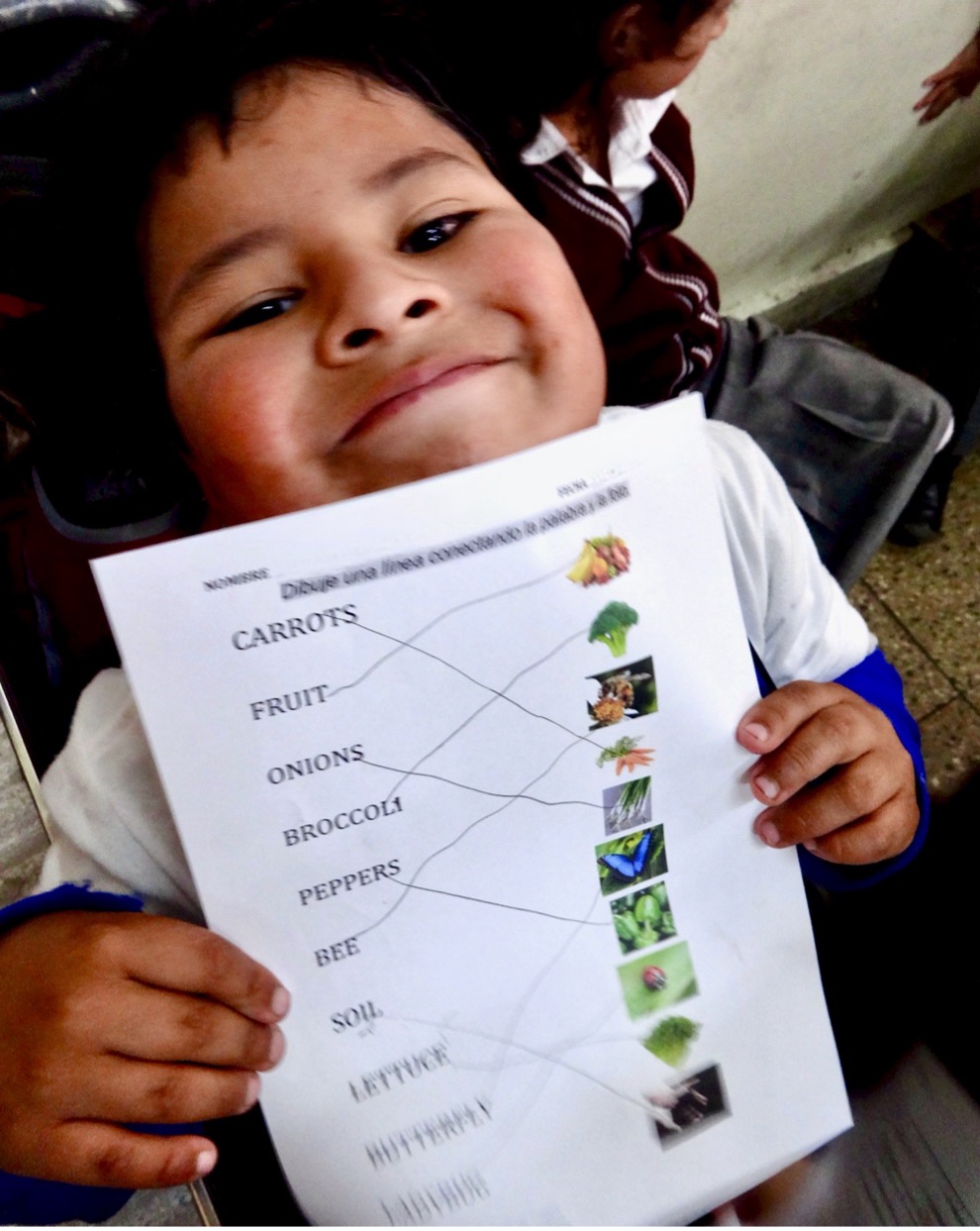
Simple vocabulary assessments – matching English words to images of hands, butterfly, water, soap, bee, ladybug, honey, and earthworm (see Figure 4) – demonstrated strong retention rates. More importantly, students spontaneously used English vocabulary during unstructured garden time, indicating genuine acquisition rather than rote memorization. One particularly memorable example came from a quiet first-grader who rarely spoke in class. After several weeks in the TiNi program, he created a colorful illustrated card depicting students working in the garden, complete with English labels for plants, tools, and activities. His spontaneous artwork became the template for completion certificates awarded to all 500 participating students, demonstrating how the program unleashed creative expression that transcended language barriers.
Cultural Relevance and Community Engagement
The program honored local cultural values by incorporating indigenous perspectives on environmental stewardship. Discussions of Buen Vivir (Good Living) – an Andean philosophy of harmony between humans and nature – provided rich contexts for exploring how different cultures express environmental ethics. Students studied native plant and animal species, traditional foods, and indigenous agricultural practices, connecting English vocabulary to their cultural heritage rather than treating the language as a purely foreign system (see Figure 5).

Our prior work teaching nutrition classes informed the curriculum in unexpected ways. The plants students cultivated carried cultural histories – herbs and flowers used not only for food but also by local curanderas (healers) in the markets, who selected specific plants for traditional healing practices. Students learned English vocabulary while discovering that their communities held sophisticated knowledge about the natural world, reinforcing TiNi’s core message that environmental stewardship emerges from cultural identity rather than external imposition.
Families participated through periodic garden celebrations where students demonstrated their English vocabulary and explained their TiNi projects. This community engagement reinforced learning while building family support for English language education.
A replication framework: Adapting TiNi to your context
The TiNi-ESL integration can be adapted to diverse educational settings. Success requires attention to five key elements:
1. Start small
TiNi requires only half a square meter of space – a single planter box, container garden, or small raised bed. Urban schools without outdoor space can use vertical gardens, windowsill herb boxes, or hydroponic systems. Rural schools might access larger garden plots or partner with community gardens. The essential element is giving students ownership of their small space to nurture life.
2. Map to existing curriculum
Rather than adding TiNi as an additional requirement, identify where it can fulfill existing objectives. Environmental vocabulary naturally supports science standards. Discussion of values and community responsibility addresses social-emotional learning goals. Art projects and presentations meet multiple content standards while reinforcing language learning.
3. Ensure cultural relevance
Adapt vocabulary themes to local environmental contexts. Students in desert climates will engage differently with water conservation vocabulary than those in rainforest regions. Students from agricultural communities bring different background knowledge than urban students. Honor these differences by choosing plants, animals, and environmental topics relevant to students’ lived experiences.
4. Plan for sustainability
Consider ongoing resource needs – seeds, soil, tools, water access. Many TiNi programs use recycled containers, school composting systems, and native plants requiring minimal water. Parent volunteers or older students can support maintenance during school breaks. Start with hardy, low-maintenance plants that tolerate beginner mistakes.
5. Build community partnerships
Connect with local environmental organizations, botanical gardens, agricultural extension offices, or university programs. These partners often provide free seeds, expertise, volunteer support, or field trip opportunities. Some may offer professional development for teachers implementing garden-based education.
Aligning practice with global goals
The TiNi-ESL integration directly supports multiple United Nations Sustainable Development Goals (SDGs), particularly SDG 4: Quality Education. Target 4.7 specifies that by 2030, all learners should gain knowledge and skills to promote sustainable development, including through education for sustainable lifestyles, human rights, gender equality, and appreciation of cultural diversity (United Nations, 2015).
By embedding English language learning within environmental education, values development, and hands-on experience, the program fulfilled this ambitious target. Students acquired not just linguistic competence but also environmental literacy and ethical consciousness – preparing them to be both proficient English speakers and engaged global citizens.
Limitations and considerations
Several limitations should be acknowledged when considering this approach. First, our assessment methods were informal – primarily vocabulary matching and observation of spontaneous language use. We did not employ standardized pre-/post-assessments that would allow statistical comparison with control groups or traditional instruction methods. Future implementations would benefit from more rigorous assessment protocols.
Second, generalizability requires caution. Our context included unique advantages: a national curriculum mandating TiNi implementation, administrative support, and a climate permitting year-round gardening. Teachers in contexts without these supports may face additional barriers. The replication framework addresses adaptability, but implementers should anticipate context-specific challenges.
Third, the approach requires teacher comfort with outdoor education, flexibility in lesson planning, and willingness to embrace “productive messiness” inherent in hands-on learning. Teachers accustomed to controlled classroom environments may need professional development support to implement TiNi-ESL integration effectively.
Fourth, while we observed strong student engagement and vocabulary retention, long-term language development outcomes remain unmeasured. Longitudinal research tracking students through subsequent grade levels would strengthen claims about lasting educational impact.
Fifth, cross-cultural knowledge transfer presents inherent challenges that merit acknowledgment. As outside practitioners introducing methods grounded in our own training and cultural context, we navigated tensions between established horticultural and pedagogical practices and local approaches. While we adapted many aspects of our implementation to honor local knowledge and culture, some methodological choices – particularly around garden construction and organization – reflected our own backgrounds rather than community-generated practices. This dynamic may have positioned the TiNi project as associated with outside expertise rather than community ownership, potentially limiting long-term adoption (Javidan et al., 2005).
Sixth, and finally, this connects to a broader sustainability concern. Despite efforts to involve parents and teachers, genuine community ownership of the project remained limited. When our Peace Corps service ended abruptly due to the COVID-19 pandemic, the program did not continue. This outcome is common in volunteer-driven international education initiatives (Chambers, 1997) and suggests that replicators should invest significantly in building local leadership capacity and institutional commitment before external support concludes. A project’s pedagogical success during implementation does not guarantee its survival afterward.
Conclusion: Beyond vocabulary lists
Three years of integrating TiNi with ESL instruction demonstrated that language learning need not be isolated from students’ values, communities, or ecological contexts. When we teach English through meaningful environmental action, we give students more than vocabulary – we offer them agency, purpose, and connection.
The 500 students who participated in this program learned that English could be a tool for expressing their love for nature, their commitment to their communities, and their hopes for a sustainable future. They discovered that learning a new language could deepen rather than diminish their cultural identity. And they experienced education as joyful, playful, and transformative.
For ESL educators seeking to make their instruction more meaningful, TiNi offers a promising framework that maintains academic rigor while honoring students’ whole development. Our experience suggests that educators in similar contexts – settings with administrative support, some outdoor space, and openness to experiential learning – may find comparable success with this approach. Whether you have access to a large garden plot or a single planter box, whether you teach in a tropical climate or adapt the model for seasonal constraints, the core principles remain: give students something meaningful to care for, connect language learning to that care, and watch both the garden and the learning flourish.
References
Anderson, D. J. (2020). TiNi program implementation: Peace Corps Ecuador final report. Peace Corps.
Chambers, R. (1997). Whose reality counts? Putting the first last. Intermediate Technology Publications. https://practicalactionpublishing.com/book/2388/whose-reality-counts
Deci, E. L., & Ryan, R. M. (2000). The “what” and “why” of goal pursuits: Human needs and the self-determination of behavior. Psychological Inquiry, 11(4), 227-268. https://doi.org/10.1207/S15327965PLI1104_01
Garcia, O., & Wei, L. (2014). Translanguaging: Language, bilingualism and education. Palgrave Macmillan. https://doi.org/10.1057/9781137385765
Hansen-Thomas, H., Gómez-Parra, M. E., & Muszyńska, B. (2025). Building classroom culture through translanguaging: Theory to practice. TESOL Press.
Hirsh-Pasek, K., Golinkoff, R. M., Berk, L. E., & Singer, D. G. (2009). A mandate for playful learning in preschool: Presenting the evidence. Oxford University Press. https://doi.org/10.1093/acprof:oso/9780195382716.001.0001
Javidan, M., Stahl, G. K., Brodbeck, F., & Wilderom, C. P. M. (2005). Cross-border transfer of knowledge: Cultural lessons from Project GLOBE. Academy of Management Executive, 19(2), 59–76. https://doi.org/10.5465/AME.2005.16962801
Krashen, S. D. (1982). Principles and practice in second language acquisition. Pergamon Press. https://www.sdkrashen.com/content/books/principles_and_practice.pdf
Ministerio de Educación del Ecuador. (2017). Guía introductoria a la metodología TiNi: Tierra de niñas, niños y jóvenes para el buen vivir. https://educacion.gob.ec/
UNESCO. (2012). Education for sustainable development sourcebook. UNESCO. https://unesdoc.unesco.org/ark:/48223/pf0000216383
United Nations. (2015). Transforming our world: The 2030 agenda for sustainable development. https://sdgs.un.org/2030agenda
Whitebread, D., Neale, D., Jensen, H., Liu, C., Solis, S. L., Hopkins, E., Hirsh-Pasek, K., & Zosh, J. M. (2017). The role of play in children’s development: A review of the evidence. LEGO Foundation. https://cms.learningthroughplay.com/media/esriqz2x/role-of-play-in-childrens-development-review_web.pdf