Language learning as educational partnership: A blended model for engaging multilingual immigrant Haitian families

This article describes the English for Education and Empowerment Certificate Program, a university–school district partnership serving multilingual Haitian immigrant families. Drawing on bilingual education, family engagement, and critical TESOL scholarship, the program integrates contextualized language instruction, translanguaging, and culturally responsive pedagogy to support parents’ English development and participation in family–school partnerships.
Keywords: Haitian Immigrant, Family Engagement, Adult Learning, Language Learning, Pedagogy, Translanguaging, Educational Partnership
Language learning at a moment of educational change
Schools across the United States increasingly serve linguistically and culturally diverse communities, making strong family–school partnerships especially important. Research consistently shows that when multilingual families can communicate with educators and participate in school communities, students benefit academically, socially, and emotionally (Auerbach, 2009; Hall, 2020; Ishimaru, 2020). However, school communication often depends on specialized forms of English and familiarity with institutional practices that may not be transparent to immigrant families navigating schooling in a new linguistic context (Norozi & Vik, 2024; Valdés, 1996). Language barriers can therefore limit families’ opportunities to participate fully in educational dialogue and decision-making (Choe, 2022).
For Haitian immigrant families developing English proficiency, these challenges coexist with rich linguistic and cultural resources and strong commitments to education (Nicholas et al., 2008). Many families navigate schooling across Haitian Creole, French, and English, drawing on multilingual practices that can support learning and engagement when recognized by schools. Asset-based approaches in multilingual education emphasize the importance of building on families’ linguistic repertoires and community knowledge to foster equitable participation and belonging within educational communities (Cummins, 2001; García & Wei, 2014; Paris & Alim, 2017). It is within this context that the English for Education and Empowerment Certificate Program was developed.
Expanding access to university-based language learning
The English for Education and Empowerment Certificate Program was developed through a collaborative partnership between a university language education initiative and a local urban school district to support multilingual parents seeking to strengthen their English proficiency while developing a deeper understanding of educational systems and family–school partnerships. The program built upon a pre-existing partnership between the university and the local school district. The partnership directors asked the faculty to design the program to address an emerging and pressing need to support Haitian immigrant families’ adjustment to U.S. school norms, which in turn empowers families to better support their children’s success. Initially, during the first pilot of the program in spring 2021, we were asked to offer this to the school system virtually due to COVID realities. Due to the success of the pilot, we were invited to offer a second iteration in spring 2022. Participation was limited to 20 parents/caregivers in both iterations of the course to support broad-based language learning opportunities and interactions.
By combining the faculty’s expertise in language instruction and international higher education with the school district’s commitment to inclusive family engagement, the initiative created opportunities for immigrant families/caretakers to access university-level language learning connected directly to their children’s schooling. Participants were recruited by the school district’s Family Liaison who was involved with a local nonprofit organization that worked to educate, support, and empower the local immigrant community. Upon successful completion of the program, including all assignments and attendance, participants received an official university certificate recognizing their participation in a structured language learning experience focused on educational communication and family engagement.
Such partnerships remain relatively uncommon within school district family engagement initiatives, which are often limited to short-term decontextualized workshops, if any, or school-based informational sessions. By contrast, this program positions immigrant families as learners within a university-level educational experience, expanding access to high-quality academic programming that is often unavailable to families seeking language learning opportunities connected directly to their children’s education.
Program description: English for education and empowerment
The English for Education and Empowerment: Emerging Bilingual Parent Advocacy Certificate Program was an eight-week, content-based English language program designed for Haitian immigrant parents/caregivers who were recruited through school-based family liaison staff in in an urban school district, who identified and invited caregivers seeking to strengthen both their English language proficiency and their ability to engage with their children’s schooling.
The program was designed and led by the authors, two faculty members with immigrant family, multilingual backgrounds, one who identifies as Haitian American and is fluent in Haitian Creole and the other with basic proficiency. Both bring complementary disciplinary expertise in TESOL/bilingual education and international higher education, as well as years of experience working with multilingual immigrant communities, informing a curriculum that is both linguistically responsive and grounded in the lived experiences of participating families. Both faculty previously co-designed and led a virtual English for Academic Purposes course for graduate students in partnership with a six-campus university in Haiti.
The program was developed with two complementary goals. First, to support multilingual parents in developing English across the four major communicative domains: listening, speaking, reading, and writing through rigorous language instruction. Second, to equip families with knowledge and strategies that support children’s educational success and strengthen communication between families and schools. Rather than treating language learning as separate from educational participation, the program integrated these goals through a content-based instructional design. Participants engaged with topics directly connected to family engagement, including navigating educational systems, communicating with teachers, participating in school meetings, and supporting children’s learning at home.
The program integrated English language development with parent advocacy and educational literacy through a blended format that combined weekly two-hour synchronous evening sessions with asynchronous, self-paced assignments designed to accommodate working caregivers’ schedules. Instruction targeted the four core language skills – reading, writing, listening, and speaking – through authentic, education-focused content and communicative tasks such as discussions, collaborative writing, and presentations. Participants were expected to attend all sessions, actively engage in in-class activities, and complete weekly assignments aligned with each module.
To support flexible and ongoing communication and a sense of community, participants and instructors engaged through a dedicated WhatsApp group, which functioned as an extension of the classroom, enabling participants to submit assignments and engage in thematic discussions. This space allowed participants to ask questions between sessions, share resources, seek clarification on assignments, and communicate in a modality that aligned with their preferences and access. The use of this platform facilitated more immediate, low-barrier interaction with faculty and supported continuity of learning beyond scheduled class time.
Course requirements included consistent participation in interactive activities (e.g., discussions, collaborative writing, presentations), completion of weekly written exercises, and engagement with assigned readings and multimedia resources. Pre- and post-assessments were administered to measure language development, and successful completion of all course components – including attendance, assignments, and the capstone project – is required to earn a certificate of participation.
The eight-week curriculum was organized thematically as follows:
- Week 1: Diagnostic Assessment and Orientation
Oral and written language diagnostics; introduction to course structure, expectations, and learning goals.
- Week 2: Navigating the U.S. Educational System
Understanding school structures and processes; strategies for supporting children’s success in school.
- Week 3: Supporting Learning at Home
Practices for reinforcing academic development in home settings; building routines and literacy practices.
- Week 4: Parental Resilience and Community Resources
Identifying community supports; developing strategies for resilience and navigating challenges.
- Week 5: Parent–Teacher Communication and Partnerships
Building effective communication strategies; engaging in school-based interactions and activities.
- Week 6: School Meetings and Advocacy
Understanding and participating in school meetings (e.g., conferences); developing advocacy skills.
- Week 7: Intercultural Perspectives on Schooling
Examining expectations of teachers, parents, and students across cultural contexts; reflecting on roles and responsibilities.
- Week 8: Capstone—Family Success Plan
Presentation and submission of a personalized action plan outlining strategies to support children’s educational success.
The program also incorporated an affinity space for participants to share experiences and strategies, supporting both language development and practical knowledge-building. Sessions incorporated discussions of authentic materials, collaborative activities, and opportunities to practice language in meaningful communicative contexts. Assessment was ongoing and performance-based, including participation, assignments, and pre/post measures. The capstone “Family Success Plan” served as a culminating demonstration of participants’ ability to apply both linguistic and content knowledge in a real-world context.
A central feature of the program was the development of a Family Success Plan: a capstone project in which participants reflected on their learning and identified strategies for supporting their children’s educational experiences. Importantly, the program adopted a parent-centered approach to learning. Participants brought extensive knowledge as caregivers and community members, and classroom dialogue invited them to share experiences, compare educational perspectives across cultures, and collectively explore strategies for supporting children’s success.
Designing lessons around educational participation
Each session in the program integrated content objectives and language objectives, allowing participants to explore educational topics while developing the linguistic resources necessary to participate in related conversations. Content objectives focused on understanding aspects of educational systems and family engagement. Language objectives focused on linguistic development such as vocabulary expansion, sentence structures, and communication strategies.
For example, a session focused on communication between families and educators included a content objective related to understanding the purposes and structures of school communication. Language objectives included identifying key vocabulary used in school communication, practicing summarizing strategies, and composing written responses.
Similarly, a session focused on educational meetings included a content objective related to understanding the roles participants play in such meetings alongside language objectives focused on question formation, clarification strategies, and educational terminology. Integrating content and language objectives allows language learning to occur through engagement with meaningful communicative practices rather than through isolated grammar exercises.
The following chart illustrates the integration of content and language objectives across four of the eight sessions, providing a representative sample of how instruction was structured. These examples demonstrate how each session intentionally aligned thematic content (e.g., parent advocacy, school engagement) with targeted language development (e.g., vocabulary, grammar, oral communication), reflecting the program’s content-based instructional design.
Table 1. Integrating Content and Language Objectives
| Session Theme | Content Objective | Language Objective | Sample Activity |
| Understanding School Communication | Identify forms of communication between educators and families | Recognize key vocabulary and summarize information | Analyze authentic school emails |
| Preparing for School Meetings | Understand roles of participants in school meetings | Practice asking questions and clarification strategies | Role-play meeting scenarios |
| Supporting Learning at Home | Explore strategies families use to support children | Use descriptive language to discuss routines | Collaborative discussion of home learning |
| Navigating Educational Systems | Develop awareness of school structures | Expand vocabulary related to educational terminology | Reading and discussion of informational texts |
A blended pedagogical framework
The instructional approach tailored for adult immigrant multilingual learners reflects the integration of several complementary pedagogical perspectives. At the center of the model, as illustrated in Figure 1, is the principle that language learning is most effective when embedded within meaningful communicative contexts. Contextualized language learning situates linguistic development within authentic tasks rather than decontextualized exercises (Brinton et al., 2003; Hyland, 2006). The model centered families’ language learning around real-world needs such as communicating with teachers, understanding school systems, and supporting their children’s education and was grounded in the principle that language develops most effectively through meaningful, purposeful use in authentic contexts.
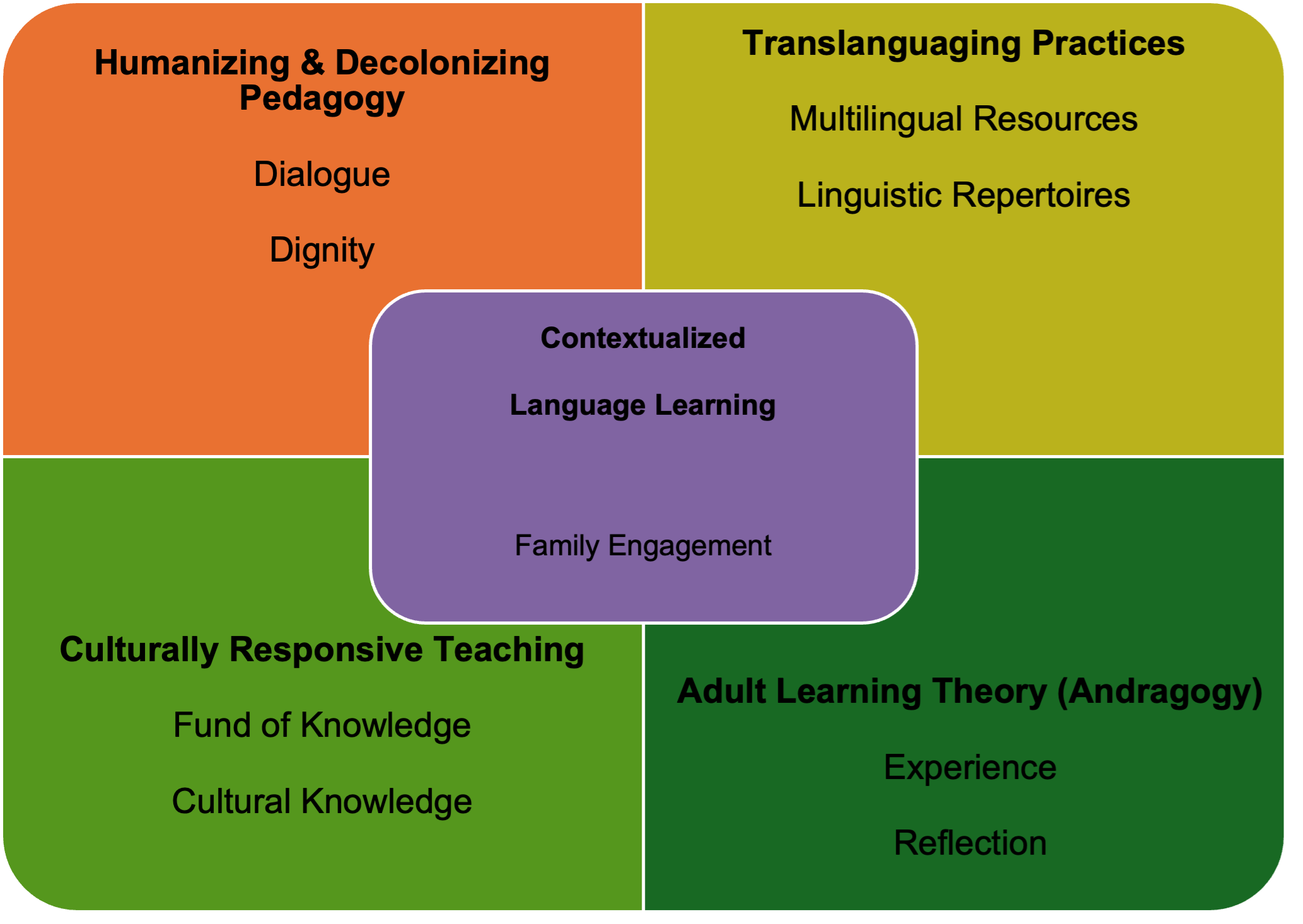
The classroom environment also reflected principles of adult learning theory, which emphasize the role of experience in adult education (Knowles et al., 2015; Merriam & Bierema, 2014). We intentionally designed a curriculum that allowed for flexible, multimodal participation structures that honored the realities of immigrant adult learners, allowing them to join from work or home, participate with cameras on or off, and engage through varied modalities; importantly, even at beginning proficiency levels, the curriculum maintained intellectual rigor, avoided reductive or “babyish” content, and incorporated learners’ voices through ongoing input and syllabus negotiation. Our curriculum reflected a commitment to dignity, agency, and authentic, context-embedded language development for adult learners. Participants’ experiences as parents served as valuable resources for dialogue and reflection.
Multilingual meaning-making also played an important role in our classroom interactions, as participants fluidly moved across languages – particularly Haitian Creole and French – to interpret texts, clarify grammar and pronunciation, and make sense of content and cultural expectations; these practices extended across speaking, writing, and group chat interactions, where learners drew on their full linguistic repertoires to explain ideas, compare structures, and support one another’s understanding. These examples reflect how translanguaging was intentionally embedded as a pedagogical approach that affirmed and leveraged multilingual resources in the co-construction of meaning (García & Kleyn, 2016; García & Wei, 2014). Translanguaging was essential to the model as it was designed to affirm learners’ identities, reduce linguistic barriers to participation, and enhance comprehension by leveraging existing knowledge, positioning multilingualism as a resource rather than a deficit in the co-construction of meaning.
The program further incorporated humanizing (Peercy et al., 2023; Salazar, 2013) and decolonizing (Kumaravadivelu, 2016) pedagogical perspectives. Humanizing pedagogies were infused such as emphasizing dialogue, dignity, and recognition of learners’ lived experiences as sources of knowledge (Freire, 1970). Embracing a decolonizing perspective, our curricular and instructional approaches intentionally challenged deficit narratives that have historically framed multilingual families as lacking knowledge about schooling; instead, we actively tapped into their sociolinguistic funds of knowledge and their Haiti-based educational experiences as relevant and legitimate (Paris & Alim, 2017). This orientation aligned closely with the concept of Funds of Knowledge (Moll et al., 1992), which highlights the rich intellectual and cultural resources present within families and communities. In practice, these approaches were enacted through dialogic learning spaces in which families shared their schooling experiences and co-constructed curriculum priorities, alongside assignments that invited participants to draw on home-based literacies such as storytelling, caregiving practices, and community knowledge as legitimate forms of learning. Instruction intentionally disrupted traditional hierarchies by positioning participants as co-educators, inviting them to contribute linguistic, cultural, and experiential knowledge that shaped classroom interactions and instructional decisions.
Haitian Creole and French were purposefully integrated as resources for meaning-making, allowing participants to move fluidly across languages to clarify concepts, express complex ideas, and support one another, thereby resisting English-only norms and affirming linguistic identities. The curriculum also created space for critical dialogue around schooling norms and inequities, supporting participants in questioning dominant norms and expectations of family engagement and developing the language and confidence to advocate for their children. In doing so, the program reframed families not as recipients of knowledge, but as knowledgeable agents capable of navigating educational systems. Importantly, the program was grounded in a trauma-informed approach that was responsive to the lived experiences of Black immigrant and refugee families, acknowledging the impacts of displacement, migration, and educational inequities, while intentionally cultivating spaces of trust, affirmation, and healing.
Program outcomes: What participants told us
We collected evaluative data through an end-of-program participant survey administered in both 2021 (Spring; n=8) and 2022 (Spring; n=6). Year two intentionally built on year one strategies and participant feedback, with the goal of strengthening the learning experience while keeping the core approach consistent. Table 2 summarizes results across the items that were asked in both years.
Table 2. Participant survey results by year (Spring 2021, n=8; Spring 2022, n=6).
| Survey item | 2021
% Strongly agree / Agree / Neutral / Disagree |
2022
% Strongly agree / Agree / Neutral / Disagree |
Change to note |
| Understood what I was supposed to learn | 50.0 / 50.0 / 0 / 0 | 50.0 / 33.3 / 16.7 / 0 | More mixed in 2022 (one neutral) |
| Enhanced ability to speak English | 62.5 / 37.5 / 0 / 0 | 50.0 / 50.0 / 0 / 0 | High in both years |
| Enhanced pronunciation | 62.5 / 37.5 / 0 / 0 | 66.7 / 33.3 / 0 / 0 | High in both years |
| Enhanced ability to read English | 87.5 / 12.5 / 0 / 0 | 50.0 / 50.0 / 0 / 0 | Still positive; fewer “strongly agree” in 2022 |
| Enhanced listening skills | 37.5 / 37.5 / 25.0 / 0 | 50.0 / 50.0 / 0 / 0 | Neutral responses dropped to 0 in 2022 |
| Course activities contributed to learning | 50.0 / 50.0 / 0 / 0 | 66.7 / 33.3 / 0 / 0 | More “strongly agree” in 2022 |
| Instructor feedback helped improve proficiency | 25.0 / 75.0 / 0 / 0 | 83.3 / 16.7 / 0 / 0 | Large increase in “strongly agree” in 2022 |
| Respectful learning environment | 25.0 / 75.0 / 0 / 0 | 83.3 / 16.7 / 0 / 0 | Large increase in “strongly agree” in 2022 |
| Authentic real-life practice scenarios | 50.0 / 50.0 / 0 / 0 | 83.3 / 16.7 / 0 / 0 | More “strongly agree” in 2022 |
| Increased understanding of supporting a child in U.S. schools | 50.0 / 50.0 / 0 / 0 | 83.3 / 16.7 / 0 / 0 | More “strongly agree” in 2022 |
| Space for Haitian bilingual families to learn together | 50.0 / 50.0 / 0 / 0 | 66.7 / 33.3 / 0 / 0 | More “strongly agree” in 2022 |
| WhatsApp oral journals improved speaking fluency (2021 only) | 50.0 / 25.0 / 12.5 / 12.5 | Not asked | More variability than other items |
| Understood how WhatsApp oral journal was evaluated (2021 only) |
37.5 / 50.0 / 12.5 / 0 | Not asked | Most understood evaluation criteria |
In both years, participants rated outcomes highly (Table 2). The biggest year-to-year shifts were increases in “strongly agree” responses in 2022 related to instructor feedback and the learning environment, as well as stronger endorsement of authentic, real-life practice and increased understanding of how to support children in U.S. schools. Listening also strengthened from 2021 to 2022, with neutral responses dropping to zero.
Open-ended responses help explain what participants experienced as most helpful. Across both years, pronunciation practice and grammar review were repeatedly named as especially valuable, often alongside discussion and opportunities to try out language in a low-stakes way. In 2021, several participants highlighted the WhatsApp oral journals as helpful because teachers could point out errors and participants could practice spoken sentences outside of class. In 2022, one participant emphasized phrasal verbs as a practical tool for communicating more concisely (“Phrasal Verbs because it taught me how shorten my sentences.”), and another described improved clarity and intelligibility when speaking (“before the course it was more difficult for me to speak clearly and make me understand by English native speaker.”).
Participants’ comments about materials and improvements also shifted across years. In 2021, responses frequently referenced the online delivery tools (e.g., Zoom and PowerPoint). In 2022, participants more consistently described the textbook and slides as “simple” and “really friendly user,” and valued being able to write in the book. Suggestions in both years emphasized the need for more time and continuation; 2022 feedback added clear requests for level differentiation (a lower-level section and/or an advanced next step) and an audio version of the textbook to support pronunciation practice outside of class.
Across both years, participants also described affective benefits (especially increased confidence) and strong appreciation for instructors. To better understand sustained impact, future iterations could include follow-up check-ins, additional surveys, and/or educator observations.
Reading the results with care
These findings should be interpreted in light of several limitations. First, the evaluation relied on small end-of-program samples (2021 n=8; 2022 n=6) drawn from families who completed the program, which limits generalizability and may overrepresent more satisfied participants. Second, outcomes reflect self-reported perceptions rather than direct, standardized assessments of language growth or caregiver advocacy behaviors, and responses may have been influenced by social desirability given the supportive, relationship-based nature of the program. Third, because the survey was administered only at program end and did not include a comparison group, we cannot determine the extent to which reported gains are attributable to the program versus other experiences, nor can we assess durability of change beyond the immediate post-program period. Finally, while the surveys included a shared core of closed-ended items, some items (e.g., the WhatsApp Oral Journal questions) were asked only in 2021, which constrains year-to-year comparability. Future evaluations would benefit from larger cohorts, consistent measures across iterations, and the inclusion of follow-up data and/or performance-based indicators to triangulate participants’ reports.
Implications for TESOL educators
Programs designed for multilingual families offer several insights for educators working in TESOL contexts. First, situating language learning within authentic institutional contexts can make language development more meaningful for adult learners. Second, recognizing learners’ multilingual repertoires through translanguaging and culturally-sustaining practices can support comprehension and collaborative learning. Third, integrating humanizing and decolonizing pedagogical approaches can create classroom environments where learners’ experiences and perspectives are valued and contribute to collective knowledge. Finally, designing authentic lessons that integrate content objectives and language objectives allows language development to occur alongside exploration of meaningful and relevant themes connected to their children’s learning.
Final thoughts: Language learning as participation
Language learning is often understood primarily as the development of linguistic proficiency. Yet language also shapes how individuals participate in institutions and communities. The English for Education and Empowerment Certificate Program illustrates how language learning can support multilingual parents/caregivers as participants in educational dialogue. By situating language development within conversations about schooling and family engagement, the program creates opportunities for learners to develop linguistic resources while participating in discussions about education. In this sense, language learning becomes not only a tool for communication but also a pathway toward meaningful participation in educational communities.
References
Auerbach, E. R. (2009). Walking the walk: Portraits in leadership for family engagement in urban schools. The School Community Journal, 19(1), 9–23.
Brinton, D. M., Snow, M. A., & Wesche, M. B. (2003). Content-based second language instruction (2nd ed.). University of Michigan Press.
Choe, D. E. (2022). Longitudinal linkages among immigrant mothers’ language proficiency, parental self-efficacy, and school involvement. Children and Youth Services Review, 136, 106438. https://doi.org/10.1016/j.childyouth.2022.106438
Cummins, J. (2001). Negotiating identities: Education for empowerment in a diverse society (2nd ed.). California Association for Bilingual Education.
Freire, P. (1970). Pedagogy of the oppressed. Continuum.
García, O., & Kleyn, T. (2016). Translanguaging with multilingual students: Learning from classroom moments. Routledge. https://doi.org/10.4324/9781315695242
García, O., & Wei, L. (2014). Translanguaging: Language, bilingualism and education. Palgrave Macmillan. https://doi.org/10.1057/9781137385765
Hall, C. M. (2020). The impact of family engagement on student achievement. Networks: An Online Journal for Teacher Research, 22(2). https://doi.org/10.4148/2470-6353.1327
Hyland, K. (2006). English for academic purposes: An advanced resource book. Routledge.
Ishimaru, A. M. (2020). Just schools: Building equitable collaborations with families and communities. Teachers College Press.
Knowles, M. S., Holton, E. F., & Swanson, R. A. (2015). The adult learner: The definitive classic in adult education and human resource development (8th ed.). Routledge. https://doi.org/10.4324/9781315816951
Kumaravadivelu, B. (2016). The decolonial option in English teaching: Can the subaltern act? TESOL Quarterly, 50(1), 66–85. https://doi.org/10.1002/tesq.202
Merriam, S. B., & Bierema, L. L. (2014). Adult learning: Linking theory and practice. Jossey-Bass.
Moll, L. C., Amanti, C., Neff, D., & González, N. (1992). Funds of knowledge for teaching: Using a qualitative approach to connect homes and classrooms. Theory Into Practice, 31(2), 132–141. https://doi.org/10.1080/00405849209543534
Nicholas, T., Stepick, A., & Dutton Stepick, C. (2008). “Here’s your diploma, Mom!” family obligation and multiple pathways to success. The Annals of the American Academy of Political and Social Science, 620(1), 237-252. https://doi.org/10.1177/0002716208322781
Norozi, S. A., & Vik, N. E. (2024). Navigating collaboration: Newcomer parents’ perceptions and experiences with Norwegian schools. Social Sciences, 13(12), 698. https://doi.org/10.3390/socsci13120698
Paris, D., & Alim, H. S. (2017). Culturally sustaining pedagogies: Teaching and learning for justice in a changing world. Teachers College Press.
Peercy, M. M., Tigert, J. M., & Fredricks, D. E. (2023). Core practices for teaching multilingual students: Humanizing pedagogies for equity. Teachers College Press.
Salazar, M. C. (2013). A humanizing pedagogy: Reinventing the principles and practice of education as a journey toward liberation. Review of Research in Education, 37(1), 121–148. https://doi.org/10.3102/0091732X12464032
Valdés, G. (1996). Con respeto: Bridging the distances between culturally diverse families and schools. Teachers College Press.